MotoAssure keeps showing up whenever a shopper searches for an extended car warranty in 2026. The brand has sponsored “consumer protection” editorials, runs a small homepage testimonials section, and now appears alongside the bigger warranty names on comparison sites. So the obvious question is: what do MotoAssure reviews actually look like once you set the marketing aside?
This guide works through the company’s structure, plan tiers, real third-party feedback (with sources), the legal rules that shape cancellation and pricing, and how MotoAssure compares to the larger players. Every factual statement below is tied to a URL retrieved for this article — anything that could not be verified has either been cut or framed as “varies by contract.”
Methodology and sources. This piece was researched in August 2026. Primary sources are MotoAssure’s own site (motoassureadmin.com), its BBB business profile, Trustpilot, two state insurance department guides, the Car Talk state-by-state service contract guide, and the official NAIC Service Contract Model Act. Third-party editorial content (e.g., the Programming Insider piece) was treated as sponsored commentary, not independent reporting.
What MotoAssure Administration Is — and What It Is Not
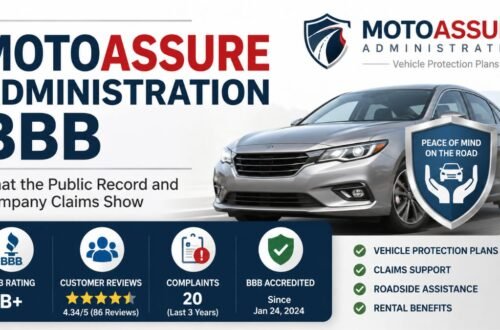
MotoAssure Administration, often shortened to MotoAssure, is a Leawood, Kansas-based administrator of vehicle service contracts (VSCs). The BBB business profile lists it under “Auto Warranty Processing,” and the company has been BBB accredited since January 2024. Its operating model is straightforward: it designs the contracts, processes claims, manages customer service, and partners with a separate risk-bearing entity that actually pays out on covered repairs (MotoAssure homepage).
That distinction matters because it is the source of most buyer confusion in this industry. A MotoAssure plan is not auto insurance, not a manufacturer warranty, and not a guarantee. It is a contract — and like any contract, it is only as good as the small print and the company standing behind it.
MotoAssure highlights one operational choice: it does not run aggressive telemarketing. Most extended-warranty providers buy lead lists and cold-call consumers, while MotoAssure leans on inbound web traffic, dealer referrals, and sponsored editorial placements (MotoAssure homepage; Programming Insider editorial).
The Coverage Tiers
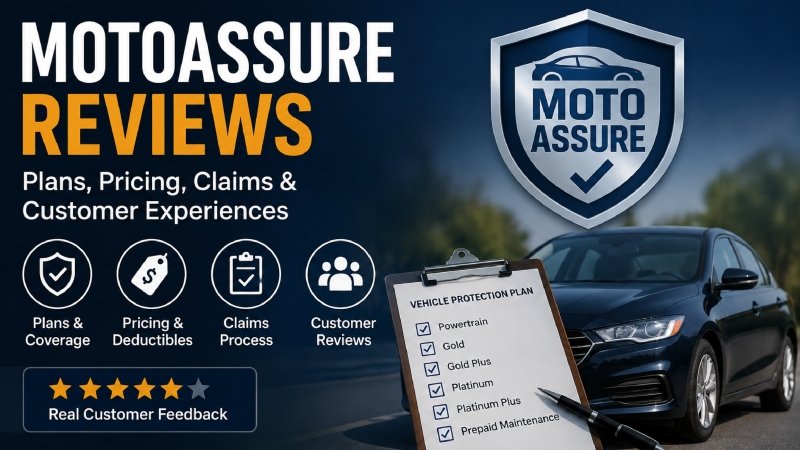
MotoAssure lists five products on its site. Pricing, exact component lists, and contract term/mileage data are not published online and are only confirmed at quote time (MotoAssure protection plans page; 24-7 Press Release, April 26 2025).
Powertrain
The base tier. Covers engine, transmission, and drive axle components. Best for older, lower-value vehicles where cost-per-dollar of coverage matters more than breadth.
Gold
A stated-component mid-tier. Adds steering, brakes (typically with wear-item exclusions), electrical, cooling, and air conditioning. Often the practical middle choice for daily drivers.
Gold Plus
According to the company’s “Customers” page, Gold Plus adds an additional five years and 100,000 miles of coverage once the original term expires, which MotoAssure frames as “two protection plans in one” (MotoAssure customers page). Exact component coverage above the Gold base is not itemized publicly and should be confirmed in the sample contract before purchase.
Platinum
The flagship tier. Marketed as MotoAssure’s most inclusive plan and described by the company as “the highest level” of coverage (MotoAssure homepage). The contract should be reviewed for the actual exclusions list, since the gap between “stated component” and “exclusionary” wording can be significant.
Platinum Plus
Per the same company page, Platinum Plus adds the additional five years and 100,000 miles of coverage once the original Platinum term ends (MotoAssure customers page). Like Gold Plus, the exact added component scope should be confirmed in the sample contract before signing.
Prepaid Maintenance (not a warranty)
A prepaid bundle of oil changes, fluid services, and basic inspections. It does not cover major breakdowns, and it should not be confused with a protection plan.
Across all tiers, MotoAssure lists a few standard benefits: 24/7 roadside assistance, towing, trip interruption, and a rental car reimbursement that begins on day one of a covered repair. The company also publishes a “limit of liability” formula: repairs are paid up to the actual cash value of the vehicle, with a $12,500 floor — meaning even a low-value vehicle retains meaningful coverage headroom (MotoAssure customers page).
Pricing: What You Actually Pay
MotoAssure does not publish prices on its website. Quotes are generated based on vehicle, mileage, condition, location, and chosen plan. The 2025 press release tied to the expanded lineup emphasizes transparency and “no hidden fees,” but it does not list sample premiums either (24-7 Press Release).
One BBB complaint that mentions pricing states the customer paid roughly $176 per month for a Platinum Plan underwritten by “American Dream” (BBB MotoAssure complaints). That figure is one customer’s experience, not a list price. Treat any “MotoAssure plans cost $X–$Y” claim you see elsewhere as marketing copy until MotoAssure itself publishes ranges.
Deductibles in this industry typically range from $100 to $250 per visit, with “disappearing” deductible options offered in some states. Confirm the exact deductible structure on the sample contract before purchase.
Cancellation and the Free-Look Window
This is the area where the marketing and the law do not quite match up. MotoAssure’s customer page implies a 30-day cancellation window, but the actual rule is set by the state where the contract is sold. There is no single federal 30-day rule for vehicle service contracts — every state writes its own.
What state law actually requires (verified examples, not a national default):
- Washington: A 9-day full-refund window with no cancellation fee; 10–30 calendar days for a full refund minus up to a $25 cancellation fee; after 30 days the refund is prorated, again with a $25 cap (Washington Office of the Insurance Commissioner).
- California: Cancellation within 30 or 60 days for a full or partial refund, with a cancellation fee capped at $25 (California Department of Insurance consumer guide).
- Florida: Up to 60 days (two months) to cancel, with administrative fees allowed (Car Talk state guide).
- Idaho and Illinois: 30-day full refund window, cancellation fee capped at $50, prorated refund after 30 days (Car Talk state guide).
- Maryland: 20-day full refund window if no claim has been filed (Car Talk state guide).
- Texas: 30-day full refund window with no cancellation fee, prorated refund after 30 days (Car Talk state guide).
- North Carolina: Cancellation at any time for a prorated refund, administrative fee capped at 10% of the refund amount (Car Talk state guide).
The underlying authority is the NAIC Service Contract Model Act, which most states have adopted with their own adjustments (NAIC Service Contract Model Act PDF). The practical takeaway: read the cancellation section of the contract you are actually signing. Your state may give you more or fewer days than the company brochure implies.
The Claims Process in Practice
When a covered component fails, the standard flow is: bring the car to an authorized repair facility, get a diagnosis, authorize teardown, and have the shop submit the claim to MotoAssure for approval before completing the repair. MotoAssure reviews the documentation, pays the shop directly for covered parts and labor (less your deductible), and you pay the shop the deductible.
MotoAssure’s customer page states that all of its claims adjusters are former mechanics, which is intended to reduce friction on legitimate claims (MotoAssure customers page). That is a real differentiator — many large providers use adjusters with no mechanical background. How it plays out on a given claim depends on the technician handling it and the specific failure involved.
What Third-Party Reviews Actually Show
Reading reviews posted on third-party platforms gives a more honest signal than testimonials hosted on the company site.
On the positive side, reviews posted on Trustpilot describe first-time claims being approved smoothly and staff picking up the phone without an extended automated menu (Trustpilot reviews of motoassureadmin.com). The trust score, however, sits at 2.5 out of 5, based on a small sample of eight reviews — so the volume is too low to call this a statistically meaningful signal either way.
Reviews posted on the BBB customer-reviews page similarly describe individual experiences ranging from one-day claim approvals to complaints about alleged misrepresentation during the sale (BBB MotoAssure customer reviews).
Complaints posted on the BBB complaints page show a recurring pattern of denied claims, sometimes citing missed maintenance records, components the administrator argues are not specifically listed, or pre-existing conditions the customer says were not disclosed during the sale (BBB MotoAssure complaints). One complaint also references a roughly $176/month Platinum Plan underwritten by “American Dream” (BBB MotoAssure complaints).
On Trustpilot, the one-star end of the spectrum tends to focus on two issues: slow responses during cancellation, and denials that arrive after the repair has already been completed, leaving the shop and the customer in the middle (Trustpilot reviews of motoassureadmin.com).
The honest synthesis: when MotoAssure pays, reviews posted on Trustpilot and BBB tend to highlight smooth handling. When it denies, the same platforms show customers who feel the company is looking for any reason to walk away. That tension is common across the VSC industry, but it is the single biggest reason extended warranties carry a poor overall reputation.
Strengths
- Plain-English contract language. Reviews posted by the company and the Programming Insider editorial both describe the contracts as readable, and the customers page reads more like a consumer brochure than legal boilerplate (MotoAssure customers page; Programming Insider editorial).
- Day-one rental and 24/7 roadside assistance are standard. Many competitors charge extra or only trigger rentals after multi-day repairs (MotoAssure customers page).
- Mechanic-background claims adjusters. Reduces approval friction on legitimate failures (MotoAssure customers page).
- BBB accreditation since January 2024. Accreditation is not a quality guarantee, but it commits the company to BBB standards and opens the arbitration path (BBB MotoAssure profile).
- No high-pressure telemarketing. For buyers tired of cold calls about “pre-approved” coverage, this is a meaningful difference (MotoAssure homepage; Programming Insider editorial).
Weaknesses
- Limited third-party review volume. Roughly eight reviews on Trustpilot and a small sample on BBB make it harder to draw statistical conclusions than with larger competitors (Trustpilot reviews of motoassureadmin.com; BBB MotoAssure profile).
- Recurring complaints around denied claims. Whether the denials are always fair is disputed, but the pattern is consistent in complaints posted on BBB (BBB MotoAssure complaints).
- Pricing is not transparent. You must share vehicle details to get a real quote, which makes apples-to-apples comparison harder (MotoAssure protection plans page).
- Cancellation friction. Even customers who cancel inside their state-mandated free-look window sometimes report delays in getting refunds processed.
- Administer, not insure. The contract is only as strong as the underlying provider that actually pays claims, and that entity is not always MotoAssure itself (MotoAssure homepage).
How MotoAssure Compares With the Big Names
MotoAssure is a smaller player than CarShield or Endurance, both of which have tens of thousands of public reviews. Looking at the same metrics across all three:
| Provider | BBB accreditation | Public review volume (ConsumerAffairs / Trustpilot) | Common strengths cited | Common weaknesses cited |
| MotoAssure | Accredited since Jan 2024 (BBB profile) | Low (≈8 Trustpilot reviews) (Trustpilot) | Plain-English contracts, day-one rental, no-telemarketing model | Limited review volume, opaque pricing, recurring denied-claim complaints |
| CarShield | Accredited (BBB profile referenced in comparison guide) | Very high — 10,000+ ConsumerAffairs reviews, 4.2-star rating (ConsumerAffairs) | Large provider network, broad plan variety, name recognition | Denied-claim complaints, higher pricing tiers, aggressive marketing |
| Endurance | Accredited (BBB profile referenced in comparison guide) | Very high — 18,300+ ConsumerAffairs reviews, 4.5-star rating (ConsumerAffairs) | Direct administrator model, broad coverage, higher transparency | Higher premiums, denied-claim complaints, longer wait times reported on some claims |
Reddit threads covering both CarShield and Endurance show the same denied-claim pattern that shows up in MotoAssure complaints — it is an industry-wide issue, not a single-company problem (Reddit r/UsedCars thread).
What MotoAssure offers that the giants do not is a smaller, more relationship-driven feel. Whether that translates into better outcomes depends on the specific vehicle, the shop, and the technician handling the claim.
Who MotoAssure Is Best For
- Drivers of vehicles with 60,000+ miles that are out of factory warranty.
- Buyers who want a stated-component or exclusionary plan without being pressured by a phone call.
- Owners who value plain-English contracts and a US-based claims team.
- Anyone comfortable paying a market-rate quote (to be confirmed per vehicle) without a published price benchmark.
MotoAssure is probably not the right fit if:
- You want the cheapest possible powertrain coverage and do not mind aggressive sales calls.
- You want a provider with thousands of public reviews and a long operational track record.
- You are buying a brand-new vehicle still under factory warranty.
Practical Tips Before You Sign
- Read the exclusions list end-to-end. Most denied claims trace back to a component or condition the contract excludes.
- Document your maintenance. Keep every receipt and digital stamp — maintenance disputes are the most common denial reason in complaints posted on BBB (BBB MotoAssure complaints).
- Use an authorized shop. Out-of-network repairs are usually reimbursable but slow down approvals.
- Cancel inside your state’s free-look window if you change your mind. Washington allows 9 days for a full refund with no fee; many other states allow 20–60 days with caps (Washington OIC; Car Talk state guide).
- Ask which company actually underwrites the plan. That is the entity with the financial obligation, and it is not always MotoAssure itself.
Final Verdict
MotoAssure Administration is a legitimate vehicle service contract administrator with transparent contract language, BBB accreditation, and a no-telemarketing model. Its reviews posted on third-party platforms show the same pattern as the wider VSC industry: customers tend to be satisfied when claims go smoothly and frustrated when they hit a gray area. For owners of high-mileage or out-of-warranty vehicles who want plain English and a real person on the phone, MotoAssure is a credible option worth quoting. The practical move is to request a MotoAssure quote, a CarShield quote, and an Endurance quote on the same day, read every line of each sample contract, and choose the plan whose exclusions you can actually live with. Visit Motoassure.blog for more details.