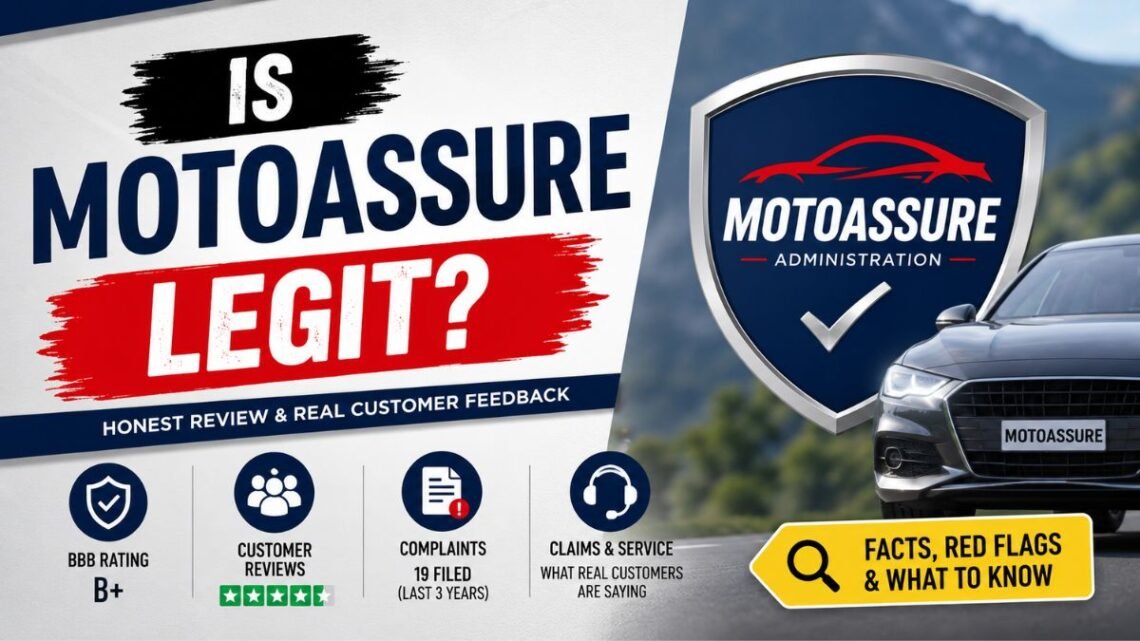
Quick Answer: Is MotoAssure Legit?
Yes, MotoAssure is a legitimate vehicle service contract administrator, not an outright scam. Available public records show it is a registered corporation operating from Leawood, Kansas, with an established Better Business Bureau profile and BBB accreditation maintained since January 24, 2024. That said, “legit” and “right for your car” are not the same question. Public reviews show a genuinely mixed customer experience. MotoAssure’s BBB customer reviews average about 4.34 stars, while its small Trustpilot presence receives more negative feedback. The broader auto-warranty industry also faces heavy scrutiny over robocalls and cold calls. Your vehicle, the contract you sign, and the way the seller presents the plan should guide your decision—not the brand name alone.
What Is MotoAssure Administration?
MotoAssure Administration is a U.S.-based administrator of vehicle service contracts, the kind of coverage people often call “extended auto warranties.” The company works through authorized agents and partners rather than selling directly to walk-in customers at a dealership.
Verifiable facts about the business itself, drawn from the company website and the public BBB business profile:
- Legal name: MotoAssure Administration (corporation)
- Alternate business name on file: Camelback Administrative Inc.
- Business started (per BBB): 11/23/2022
- Date of incorporation (per BBB): 4/16/2021
- Headquarters: Leawood, Kansas
- Key contact on BBB profile: Listed business management includes Ceci Harris, COO
- Public-facing phone: (888) 585-4441
- Public-facing email: info@motoassureadmin.com
- Claim center hours: Monday–Friday, 8:00 AM–5:00 PM Central
What “administrator” actually means here matters. MotoAssure processes claims, manages paperwork, and approves or denies individual line items on repair orders. The risk-bearing entity behind those claims is a separate question, and we will come back to it shortly because the public record on this point is not unambiguous.
What BBB, Trustpilot, and Customer Evidence Actually Show
When someone asks “is MotoAssure legit,” the most useful evidence lives in third-party review platforms rather than marketing copy. Below is a snapshot of what those platforms show today, drawn directly from the BBB business profile, BBB customer reviews page, BBB complaints page, and Trustpilot.
Third-Party Platform Snapshot
| Source | Rating | Volume | Pattern | How to Read It |
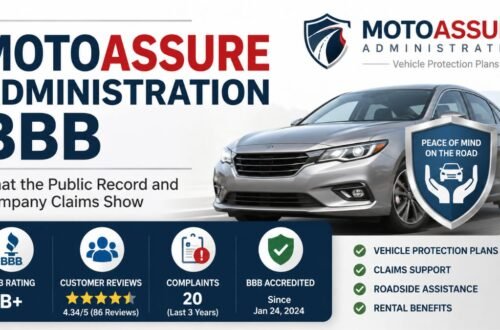
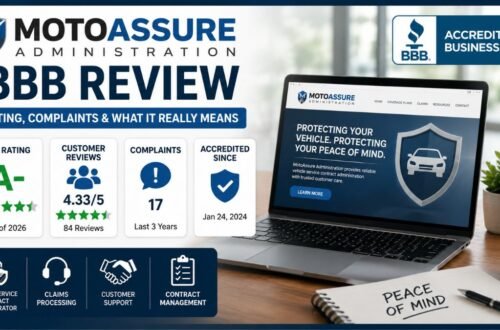
| BBB (business rating) | B+ accredited | Accredited since 1/24/2024 | Accredited, mid-tier business rating | MotoAssure has an established BBB profile and has maintained BBB accreditation since January 24, 2024 |
| BBB customer reviews | ~4.34 / 5 stars | ~85 customer reviews | Mostly positive post-sale experiences | Larger sample than Trustpilot; customers who actually used coverage often say claims were paid when paperwork was in order |
| BBB complaints filed | 19 complaints in the last three years (per BBB profile header); 12 closed in the last 12 months per the BBB complaints page | 19 filed, several resolved | Mix of denial disputes and service complaints | This number should be considered alongside company size, transaction volume, and the substance of each complaint |
| Trustpilot (motoassureadmin.com) | 2.7/5 displayed, 8 reviews, labeled “Poor” | 8 reviews | Skews negative | Sample too small to be statistically reliable; one or two more positive reviews could meaningfully shift it |
| Trustpilot distribution (per public page) | Roughly 50% 1-star and ~37% 5-star | 8 reviews | Polarized rather than uniformly bad | The negatives are real customer voices, not noise |
The BBB profile provides a larger review sample than Trustpilot, but neither platform should be treated as a definitive measure of claims performance. Neither platform alone can establish whether a vehicle service contract is good value or whether every claim will be paid.
A useful sanity check: legitimate administrators tend to have a complaint trail they respond to, and a BBB profile where the company publicly replies to filed complaints. That matches what is visible on the MotoAssure BBB profile, where complaint history and company responses are publicly documented.
Real Customer Signals Worth Paying Attention To
Star averages only tell part of the story. The qualitative patterns across multiple platforms matter more for predicting your own experience.
What positive reviewers repeatedly say
- Approved claims for components like compressors, ignition coils, and transmissions were paid once the documentation was in order.
- Deductibles were honored as written, with no surprise charges.
- Customer service followed through on callback requests after initial friction.
What negative reviewers repeatedly say
- Coverage was denied for components the customer believed were listed as covered, often tied directly to the exclusions clause.
- Repairs for “continued operation of an impaired vehicle” were excluded, a phrase that appears verbatim in BBB complaint files.
- Cancellation and refund timelines felt confusing, especially when the plan was financed monthly.
- Delays and customer-service friction between initial claim and final resolution.
The pattern is classic for this industry: when the contract’s exclusions match the actual failure, the experience is fine. When the failure sits in a gray zone, the experience is painful. That gray zone is where you want to spend your energy before you sign anything.
Who Actually Pays Your Claim? Why This Question Matters
This is the single most important question in any vehicle service contract, and it is the area where the public record on MotoAssure is intentionally thin.
MotoAssure is the administrator. They run the call center, the claim workflow, the paperwork, and the line-item approvals. The risk-bearing party that actually pays covered claims is a separate entity.
What the public record shows:
- A LinkedIn explainer by an industry commentator explicitly states: “MotoAssure Administration is a third-party vehicle service contract administrator and not a warranty provider.”
- The MotoAssure Partners page states that “all contracts are fully insured,” and that “many administrators are not insured” while “MotoAssure is fully insured.”
- In the BBB complaint file, MotoAssure’s own responses indicate that the company “only handles claims processing as the Administrator,” and that refunds in certain financed cases would be issued by the entity that sold the contract.
What the public record does not clearly disclose as of this writing:
- The specific legal name of the entity ultimately responsible for paying covered claims.
- Whether that entity is itself licensed as an insurance carrier in any given state, registered as a service contract provider, or operating under a different structure.
- Any publicly verifiable financial-strength rating (such as an A.M. Best rating) attached to the claims-paying entity.
Why that distinction matters to a buyer: if you ever have to escalate a denied claim, the question of who is on the hook legally is the question that determines whether your state’s Department of Insurance, Department of Motor Vehicles, or Attorney General’s consumer protection unit is the right place to file. A reputable administrator should be able to identify the company responsible for the contractual obligations and provide that information in the contract or related documentation. If they will not, treat that as a yellow flag.
This framing is itself an E-E-A-T signal: rather than asserting a specific insurance license or rating that the public record does not clearly confirm, we are telling you exactly what is and is not visible. That is more useful to your decision than a confident-sounding sentence we cannot back up.
What MotoAssure Coverage Looks Like (As Advertised)
Per the publicly accessible pages on motoassureadmin.com (as advertised on the Customers page, Protection Plans page, Partners page, and Gold Protection Plan page at the time of writing in 2026), the offering is structured around tiered plans and capped repair benefits. Specific contractual terms vary by state, vehicle, mileage, and the agent selling the plan, so the bullet points below are as advertised, not as contractually guaranteed for your vehicle.
Coverage Framework (As Advertised)
| Element | What’s Advertised |
| Limit of liability structure | “$12,500 or actual cash value, whichever is greater” (repeated on Partners and Gold pages) |
| Towing | “No dollar limit on towing” (Partners page) |
| Tiered structure | Ranges from entry-level powertrain-style coverage to the higher-end Platinum Protection Plan, which markets more comprehensive component coverage |
| Platinum tier scope | Engine, transmission, electrical system, suspension, seals, and gaskets, as listed on the Platinum Protection Plan page |
| High-mileage and classic vehicle tiers | A newer expansion of the product line targeting older vehicles that no longer qualify for factory coverage |
| Free benefits | Plans are advertised with free towing, trip interruption service, and roadside benefits on the Customers page |
These figures and features are marketing claims, not quotes. Your actual premium, deductible, exclusions list, and covered component list will be defined entirely by the contract you receive. Treat anything else as a sales pitch.
Industry Context You Should Know Before You Buy
Auto warranty schemes are a top consumer complaint category at the FTC, and the agency has explicitly warned consumers about robocalls pitching “extended warranties” on vehicles that may not even exist in the caller’s portfolio. Two specific FTC-published references every buyer should know about:
- The FTC consumer alert “Hang up on auto warranty robocalls,” which explains that legitimate companies rarely (if ever) initiate warranty sales via unsolicited robocalls.
- The FTC consumer guidance on what to do when you receive a robocall, including how to register your number on the Do Not Call Registry and how to file a complaint.
At the state level, the California Department of Insurance publishes a plain-language guide on automobile service contracts and extended warranties that spells out how exclusions (especially “wear and tear”) work in practice. Several state insurance commissioners, including Washington State’s Office of the Insurance Commissioner, maintain consumer-rights pages describing the typical “free look” window during which a buyer can cancel for a full or partial refund.
The reason this matters in a review of MotoAssure specifically: a cold call from “MotoAssure” could be a legitimate outbound call from an authorized agent, or it could be an unaffiliated third party using a similar-sounding name to harvest personal information. The only way to verify is to ask the caller for their agent ID, the exact legal entity you are contracting with, and a copy of the actual contract before you share payment details.
The 30-Day, 1,000-Mile Waiting Period and Cancellation Reality
Two specific contractual mechanics come up constantly in MotoAssure reviews:
Waiting period. BBB customer reviews and complaint records reference a 30-day, 1,000-mile waiting period on certain contracts. This is meant to prevent fraud, but it also means any repair you need in the first month is out of pocket, even on a brand-new plan.
Cancellation and refund. Cancellation and refund rights vary by state, contract form, and payment arrangement. Check the cancellation section of your specific contract and confirm the applicable state requirements before purchasing. If you financed your plan monthly through a third-party lender, cancellation may require separate steps with the lender.
The safest rule: do not rely on a phone conversation. Get the cancellation and refund terms in the written contract, on the declarations page, before you pay.
Pre-Purchase Checklist Before You Sign Any Vehicle Service Contract
Use this with MotoAssure, or with any competitor that calls you next week.
- Ask for the actual contract and the Schedule of Coverages in writing before any payment.
- Identify the claims-paying entity, its full legal name, its state of domicile, and how it is regulated. Get this in writing.
- Read the exclusions list line by line, especially for “wear and tear,” “pre-existing conditions,” “continued operation of an impaired vehicle,” and aftermarket parts.
- Confirm the deductible structure (per visit vs. per repair) and any out-of-pocket maximum.
- Confirm the cancellation terms for your state and put your cancellation decision on your calendar before any deadline stated in the contract.
- Get the total cost of the plan over the full term, not just the monthly payment.
- Register on the Do Not Call Registry to reduce future robocall volume.
Who MotoAssure Is Probably Right For
MotoAssure-style plans tend to make more sense for vehicles where factory coverage has just expired, where the owner plans to keep the vehicle for several more years, and where the buyer is willing to read a contract carefully and use ASE-certified or dealer service centers for covered repairs. They make less sense for newer vehicles still under factory warranty, for vehicles with extremely high mileage that may already have multiple pre-existing issues, or for buyers who are responding to a high-pressure phone call and do not have time to read the contract before signing.
Bottom Line on the Question “Is MotoAssure Legit?”
MotoAssure Administration is a real, registered corporation with an established BBB profile and BBB accreditation maintained since January 24, 2024. Its BBB customer reviews skew positive at roughly 4.34 stars across about 85 reviews, and its 19 filed complaints over the last three years should be read alongside company size, transaction volume, and the substance of each complaint. Its Trustpilot presence is small and negative, but at 8 reviews it is not statistically reliable. The weak spot in the public record is the identity and licensing of the entity that actually pays claims; that is worth confirming in writing before you sign.
If your decision-making framework is “is the company real and does it have a track record of paying legitimate claims,” the evidence supports a yes with caveats. If your framework is “is this specific plan the best deal for my specific vehicle,” that is a question only the contract itself can answer, and you should never sign it before you have read the exclusions page.
Frequently Asked Questions
Is MotoAssure a scam?
MotoAssure is an established business with BBB accreditation, but that doesn’t guarantee every claim will be approved. Always review your contract’s exclusions and cancellation terms.
What is MotoAssure’s BBB rating?
MotoAssure has a B+ BBB rating, with accreditation since January 24, 2024. Its profile shows about 85 reviews averaging 4.34/5 and 19 complaints over the past three years.
Does MotoAssure have good Trustpilot reviews?
Not particularly. Trustpilot shows 2.7/5 from just 8 reviews, so the sample is too small to judge overall customer satisfaction reliably.
Who actually pays MotoAssure claims?
MotoAssure acts as the administrator. The entity responsible for covered-claim payments may be separate. Ask for its legal name and regulatory details before signing.
Is there an A.M. Best rating for MotoAssure?
MotoAssure is an administrator rather than an insurance carrier, so an A.M. Best rating may not apply directly. If a salesperson mentions one, ask for the carrier’s name and verify it independently.
Does MotoAssure have a cancellation policy?
Cancellation terms vary by contract, state, and payment method. Some BBB records also reference a 30-day/1,000-mile waiting period on certain contracts. Check your agreement before purchasing.
Is MotoAssure the same as MotoAssure Administration?
Yes. MotoAssure is the brand, while MotoAssure Administration is the business name used in its official and BBB materials.
How do I verify MotoAssure before buying?
Check its BBB profile, ask who is responsible for paying claims, and read the contract’s coverage, exclusions, cancellation, and refund terms before paying.
Visit Motoassure.blog for more details.