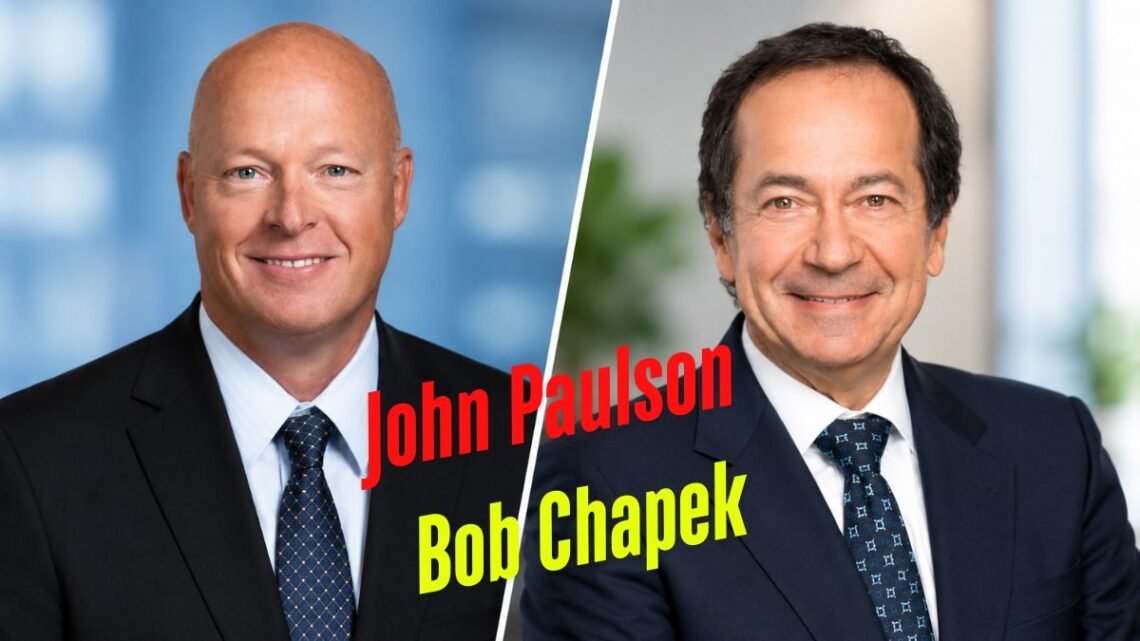
John Paulson and Bob Chapek built their careers in different areas of the American business world. Paulson became widely known for his investment decisions, particularly his bets against the U.S. housing market before the 2008 financial crisis. Chapek spent decades at The Walt Disney Company, working across consumer products, theme parks, and corporate management before becoming its chief executive officer. Comparing John Paulson and Bob Chapek reveals how their professional backgrounds shaped their approaches to investment decisions, business leadership, and major career challenges.
Although both men reached prominent positions in their respective fields, their responsibilities were very different. Paulson focused on financial markets and investment opportunities, while Chapek managed large business operations within one of the world’s best-known entertainment companies. Their careers provide two distinct examples of leadership, strategic decision-making, and professional achievement.
Who Is John Paulson?
John Paulson is an American investor and the founder of Paulson & Co., an investment management firm established in 1994. He gained international recognition after his firm made major investments against mortgage-related securities before the U.S. housing market collapsed in 2007 and 2008.
Paulson’s career demonstrates the potential rewards and risks of identifying opportunities that other investors may overlook. His work has been associated with event-driven investing, a strategy that seeks to benefit from significant developments affecting companies, financial markets, or asset prices.
John Paulson’s Early Life and Education
Paulson was born in Queens, New York, in 1955. He studied finance at New York University, graduating in 1978, and later earned an MBA from Harvard Business School in 1980.
His education provided a foundation for a career in finance and investment management. After completing his studies, Paulson worked at several financial firms, including Boston Consulting Group, Odyssey Partners, Bear Stearns, and Gruss Partners.
These roles gave him experience in business analysis, financial markets, and investment research. Over time, he developed the expertise that helped him establish his own investment management company.
Building Paulson & Co.
Paulson founded Paulson & Co. in 1994. The firm became known for its event-driven investment approach, which involves evaluating major financial or corporate developments to identify potential investment opportunities.
Rather than relying exclusively on conventional market trends, event-driven investors examine situations such as mergers, acquisitions, corporate restructuring, and changes in the value of financial securities. These strategies require detailed research, careful risk assessment, and an understanding of how economic developments may affect asset prices.
Paulson’s reputation grew substantially during the years leading up to the 2008 financial crisis. His investment decisions during that period brought him attention across the financial industry and made his career a widely discussed example of anticipating a major market downturn.
However, investment success does not eliminate risk. Paulson’s later investment performance varied across different market conditions, illustrating that strategies that succeed during one period may not produce the same results in another.
John Paulson and the 2008 Financial Crisis
One of the defining events in Paulson’s career was his firm’s position against parts of the U.S. subprime mortgage market before the financial crisis.
During the housing boom, lenders issued mortgages to borrowers with varying credit histories. These loans were often packaged into mortgage-backed securities, which were then sold to investors. As housing prices declined and mortgage defaults increased, many securities connected to the housing market lost substantial value.
Paulson’s firm used credit default swaps and other financial positions to benefit from the deterioration of mortgage-related investments. Credit default swaps are financial contracts that can provide protection against a borrower’s failure to meet certain debt obligations. Depending on their structure and the market’s movements, they can also be used to take positions on the creditworthiness of a company or financial instrument.
When the housing market weakened, Paulson’s strategy generated enormous profits for his firm and became one of the most prominent investment stories associated with the crisis.
The episode strengthened his public reputation as an investor capable of identifying serious weaknesses in financial markets. At the same time, it highlighted how complex financial instruments can create substantial gains or losses depending on market conditions and investment decisions.
John Paulson’s Philanthropy and Educational Contributions
Beyond investing, Paulson has become known for supporting educational institutions and other philanthropic causes.
In 2015, he donated $400 million to Harvard University to support its School of Engineering and Applied Sciences. Following the gift, the school was named the Harvard John A. Paulson School of Engineering and Applied Sciences.
The donation became a significant part of Paulson’s public profile beyond the financial industry. It also demonstrated his interest in supporting higher education and scientific research.
His philanthropic activities form a separate part of his legacy, alongside his work in investment management and his role in one of the most widely discussed financial trades of the early twenty-first century.
Who Is Bob Chapek?
Bob Chapek is an American business executive best known for his long career at The Walt Disney Company and his tenure as its chief executive officer. Before becoming CEO, he held senior roles across several of Disney’s major business divisions, including consumer products, theme parks, and experiences.
Chapek’s career involved managing businesses that depend on customer demand, brand recognition, operational planning, and long-term investment. His experience differed from Paulson’s focus on financial markets, but both careers involved making decisions in environments shaped by economic conditions and changing business priorities.
Bob Chapek’s Education and Early Career
Chapek studied microbiology at Indiana University Bloomington and later earned an MBA from Michigan State University.
Before joining Disney, he worked in marketing and brand management, including positions at H. J. Heinz and the advertising agency J. Walter Thompson. These early roles gave him experience in consumer products, marketing strategy, and business development.
Chapek joined The Walt Disney Company in 1993. Over the following decades, he took on responsibilities across several divisions, gradually advancing into senior leadership.
His progression at Disney reflected a career built around commercial operations and the management of products, services, and experiences for consumers.
Bob Chapek’s Rise Through Disney
Chapek held several important leadership positions before becoming CEO. He served as president of Disney Consumer Products from 2011 to 2015, overseeing activities connected to the company’s merchandise, licensing, and consumer-product businesses.
In 2015, he became chairman of Walt Disney Parks and Resorts. In that position, he was responsible for a major business division that included theme parks and related experiences.
He later became chairman of Disney Parks, Experiences and Products in 2018. His responsibilities included businesses that relied on tourism, guest spending, entertainment experiences, and Disney’s intellectual property.
These positions gave Chapek extensive experience managing large operations and coordinating different parts of an international entertainment business. They also placed him in roles where customer expectations, operating costs, investment requirements, and market conditions could significantly influence results.
Bob Chapek as Disney CEO
Bob Chapek became chief executive officer of The Walt Disney Company on February 25, 2020, succeeding longtime CEO Bob Iger.
His appointment came shortly before the COVID-19 pandemic disrupted the global economy. Restrictions on travel and public gatherings created serious challenges for Disney’s theme parks, cruise operations, theatrical releases, and other businesses that depended on in-person activity.
During his tenure, Disney continued operating and expanding its streaming business while managing the financial and operational effects of the pandemic. The period also brought difficult decisions involving costs, staffing, content strategy, and the company’s broader business priorities.
Chapek’s leadership faced public scrutiny during a challenging period for the entertainment industry. His tenure ended in November 2022, when Disney announced that Bob Iger would return as CEO.
Chapek’s time in the position was relatively short compared with some of Disney’s previous leadership tenures. Nevertheless, his career before and during the CEO role provides a useful example of the demands involved in managing a large entertainment company during an extraordinary period of economic disruption.
John Paulson and Bob Chapek: Career Comparison
John Paulson and Bob Chapek achieved professional recognition through different types of work. The following table summarizes their backgrounds and major career milestones.
| Category | John Paulson | Bob Chapek |
| Primary field | Investment management and finance | Entertainment and corporate management |
| Best known for | Founding Paulson & Co. and his position against mortgage-related securities before the 2008 crisis | Serving as CEO of The Walt Disney Company |
| Education | New York University and Harvard Business School | Indiana University Bloomington and Michigan State University |
| Major organization | Paulson & Co. | The Walt Disney Company |
| Career focus | Investment research, financial markets, and portfolio strategy | Consumer products, theme parks, and entertainment operations |
| Notable milestone | Major gains from investments tied to the U.S. housing market downturn | Becoming Disney CEO in February 2020 |
| Major professional challenge | Navigating changing financial markets and investment risks | Leading Disney through the COVID-19 disruption and related business challenges |
| Philanthropic or leadership profile | Known for a major gift to Harvard University | Known primarily for his executive roles at Disney |
The comparison shows that Paulson’s work centered on evaluating financial opportunities and managing investment positions, while Chapek’s career focused on operating and leading businesses. Their professional achievements should be assessed according to the responsibilities and challenges associated with their respective fields.
Are John Paulson and Bob Chapek Connected?
John Paulson and Bob Chapek are both prominent American business figures, but their careers developed in separate professional environments.
Paulson is primarily associated with investment management and financial markets. Chapek is associated with Disney’s consumer products, theme parks, and corporate leadership. Their publicly known career histories do not, by themselves, establish a direct personal or professional relationship between them.
It is important to distinguish a comparison between two public figures from evidence of an actual connection. Similar levels of business prominence do not necessarily mean that two people worked together, invested together, or maintained a personal relationship.
Based on their widely reported professional backgrounds, the more useful way to examine John Paulson and Bob Chapek is to compare their career paths, leadership responsibilities, and responses to business challenges rather than assume an unverified connection.
Different Approaches to Business Leadership
Paulson and Chapek operated in different environments, which influenced the decisions they made throughout their careers.
Paulson’s work required assessing financial information, evaluating risk, and identifying potential changes in asset values. His position against mortgage-related securities before the 2008 crisis illustrates how extensive research and a willingness to take a contrarian position can produce major results. It also shows the uncertainty inherent in financial markets, where investment outcomes depend on timing, market movements, and risk management.
Chapek’s leadership responsibilities involved overseeing large teams and business divisions, managing customer-facing operations, and making decisions that affected a major entertainment brand. His CEO tenure coincided with an exceptional global disruption, making operational continuity and business adaptation central challenges.
Their careers highlight different dimensions of leadership. Investment management often emphasizes financial analysis, portfolio decisions, and risk assessment. Corporate leadership places greater emphasis on operations, organizational priorities, customer experiences, and coordination across business units.
Neither career provides a universal formula for success. Instead, their experiences illustrate how professional judgment must respond to the demands and uncertainties of a particular industry.
Conclusion
John Paulson and Bob Chapek built their reputations through distinct career paths. Paulson became a prominent investor through his work at Paulson & Co. and his firm’s major position against mortgage-related securities before the 2008 financial crisis. His later philanthropic contribution to Harvard University added another important dimension to his public profile.
Chapek spent decades at The Walt Disney Company, advancing through consumer products and theme park leadership before becoming CEO in 2020. His tenure coincided with the COVID-19 pandemic and ended in November 2022, when Bob Iger returned to the role.
Comparing John Paulson and Bob Chapek offers insight into two different forms of business leadership: investment strategy and corporate management. Although their careers developed in separate industries, both illustrate the importance of decision-making, experience, and adapting to changing circumstances. Their professional histories are worth examining on their own merits, without assuming a direct connection that their publicly known careers do not establish. Visit Motoassure.blog for more details.